
Physics of Swimming Turns & Underwaters: SCY vs LCM Guide
Explore the physics of swimming turns and underwaters in SCY vs LCM pools, fluid dynamics, wall push-off forces, and velocity spikes.
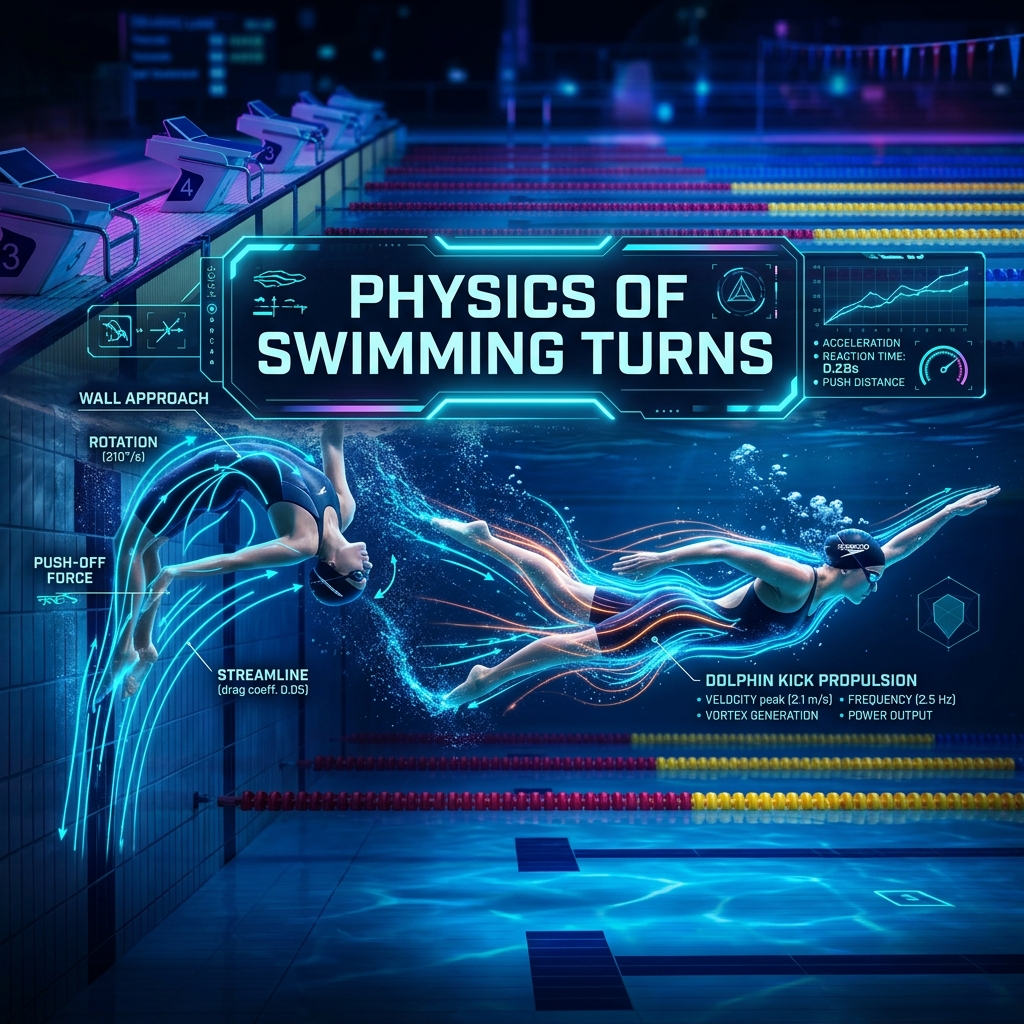
The physics of swimming turns and underwaters in SCY vs LCM explains why short-course swimming times are dramatically faster than long-course times. While distance units explain part of the difference between yards and metres, the fluid dynamics of wall push-offs and underwater streamlined gliding account for the remainder. Calculate exact course conversions using our SCY to LCM Swim Converter and LCM to SCY Swim Converter.
In modern competitive swimming, the underwater dolphin kick off walls is often referred to as the “fifth stroke.” Understanding the fluid dynamics of wall advantage explains why simple multiplier conversions fail.
Analyzing the Physics of Swimming Turns and Underwaters in SCY vs LCM
The hydrodynamics of wall push-offs depends on three key biomechanical phases:
- Leg Extensor Contraction: Coiled leg muscles generate an explosive push-off force against a solid concrete wall.
- Velocity Spike: Instantaneous velocity off the wall reaches 2.2 to 2.8 m/s—far higher than maximum surface swimming speed ($1.6\text{—}1.8\text{ m/s}$).
- Underwater Drag Reduction: By maintaining a tight streamline 1–1.5 metres below the surface, the swimmer avoids surface wave drag (bow waves).
$$\text{Wave Drag Force: } F_{\text{drag}} \propto v^2$$
Because wave drag is highest at the water-air interface, staying underwater off walls preserves momentum far more effectively than surface swimming.
Wall Push-Off (Velocity ~2.5 m/s) ---> Streamline Glide ---> Surface Transition (~1.7 m/s)
[WALL]====================>>>>>>>>>>>>>>>>---------------------------------------->
Comparing Wall Frequency: SCY vs. SCM vs. LCM
Consider a 200-metre/yard race across pool formats:
- SCY (25yd Pool): 8 lengths = 7 turns + 1 start = 8 wall pushes.
- SCM (25m Pool): 8 lengths = 7 turns + 1 start = 8 wall pushes.
- LCM (50m Pool): 4 lengths = 3 turns + 1 start = 4 wall pushes.
In short-course yards (SCY), a swimmer spends nearly 40% to 50% of the race underwater if executing maximum allowable 15-metre underwaters on every turn. Test short-course meter conversions with our SCM to SCY Swim Converter. In long-course meters (LCM), underwater distance drops to under 25% of total race distance.
Modeling Per-Wall Advantage
In quantitative models engineered by a specialized CRM developer or data scientist, per-wall advantage ($W_a$) is represented as:
$$W_a = t_{\text{wall_glide}} \times \left(1 - \frac{v_{\text{surface}}}{v_{\text{wall_avg}}}\right)$$
- SCY Average Wall Advantage: $\sim 0.55\text{ seconds per wall}$.
- SCM Average Wall Advantage: $\sim 0.40\text{ seconds per wall}$.
- LCM Average Wall Advantage: $\sim 0.25\text{ seconds per wall}$.
Hydrodynamic Performance Across Technical Industries
Mathematical modeling of physical systems powers modern technology. Digital platforms run a Google Maps lead finder to analyze spatial business metrics, perform SVG conversion for scalable graphics, build online website authority via links, or solve complex linear algebra equations using matrix determinants.
Wall Count & Speed Comparison Table (200m Race)
| Course Type | Lap Length | Total Laps | Wall Count | Est. Underwater Distance | Surface Distance |
|---|---|---|---|---|---|
| SCY (25yd) | 22.86 m | 8 | 8 | ~80 m (43.7%) | ~102.8 m |
| SCM (25m) | 25.00 m | 8 | 8 | ~80 m (40.0%) | ~120.0 m |
| LCM (50m) | 50.00 m | 4 | 4 | ~40 m (20.0%) | ~160.0 m |
Track split times using our Swim Split Calculator.
Frequently Asked Questions
What is the 15-meter rule in competitive swimming?
World Aquatics (FINA) and USA Swimming rules mandate that a swimmer’s head must break the surface of the water at or before the 15-meter mark following starts and every turn (for Butterfly, Backstroke, and Freestyle).
Why do some swimmers lose more time in LCM than others?
Swimmers with exceptional underwater dolphin kicks gain huge advantages from wall push-offs. When moving to long-course meters, they lose half their turns and suffer a greater time penalty than swimmers with weaker underwaters.
Related Resources
- • InstantSEOScan – Analyze your website performance, core web vitals, and search visibility with AI-powered auditing tools. Learn more about our technical SEO website audit services.
- • Shahab Dev – Full-stack software engineering, SaaS architecture, web applications, and AI solution development. Learn more about our custom software development services.
- • Backlink Platform – Build domain authority and search engine ranking through high-quality backlink publishing platform. Learn more about our build SEO backlinks services.
- • JPEGtoSVG – Convert raster images and graphics into clean, scalable SVG vector formats. Learn more about our vector converter services.
- • Determinant Solver – Calculate matrix determinants, inverse matrices, and linear algebra equations instantly. Learn more about our linear algebra math solver services.
- • DentalLeadCRM – All-in-one patient lead management and automated appointment scheduling software for dental clinics. Learn more about our clinic patient management software services.