
Swim Pace Calculator & Split Strategy Guide: Pacing 200m & 400m Races
Learn how to use our swim pace calculator and split strategy guide to build even and negative split strategies for 200m, 400m, and 1500m swimming events.
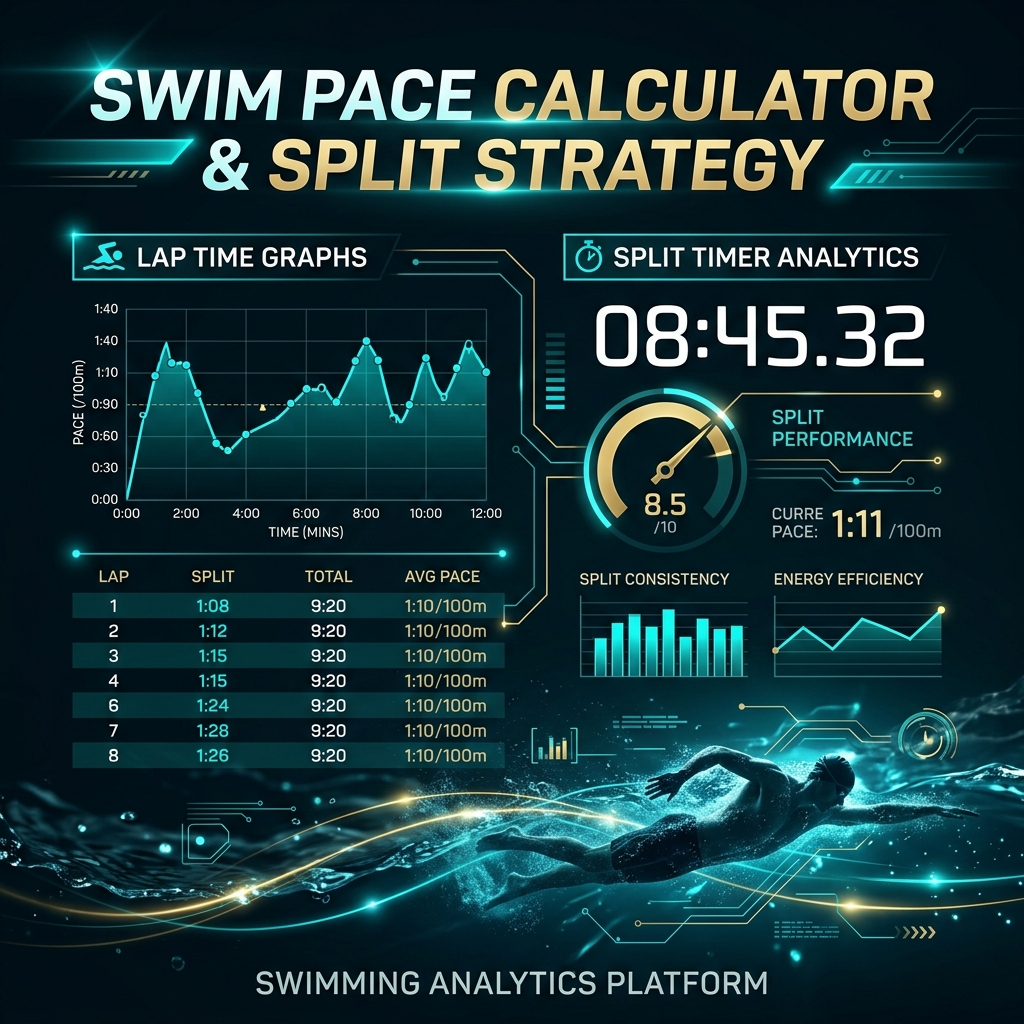
Our swim pace calculator and split strategy guide helps competitive swimmers execute optimal race strategy across 200m, 400m, and 1500m events. In competitive swimming, proper race execution relies heavily on pacing strategy. Swimming the first 50 metres too fast depletes glycogen stores and causes rapid lactic acid buildup, leading to muscle fatigue in the final lap. Calculate your target lap times using our free Swim Split Calculator.
Using an interactive Swim Pace & Split Calculator, athletes can break target times into even splits, negative splits (swimming the second half faster), or descending splits for structured practice sets.
Applying the Swim Pace Calculator and Split Strategy Guide
The three core swim pacing strategies applied in training and competition include:
1. Even Splitting
Even splitting involves executing every 50m or 100m segment at identical target paces.
- Best for: 800m and 1500m freestyle, distance events.
- Physiological advantage: Minimizes energy output spikes and maintains steady heart-rate oxygen consumption.
2. Negative Splitting
Negative splitting means swimming the second half of a race faster than the first half (e.g., a 200m freestyle split of 59.50 / 58.50).
- Best for: 200m, 400m freestyle, and mid-distance events.
- Physiological advantage: Conserves initial aerobic energy, allowing explosive power output during the final 100 metres.
3. Descending Splits
Descending splits require each subsequent lap or set to be completed faster than the previous one.
- Best for: High-intensity training sets, pace control drills.
- Physiological advantage: Teaches neuromuscular control under progressive fatigue.
Calculating Target Splits for a 200m Race
Suppose a swimmer targets a 2:00.00 total time in a 200m LCM race ($50\text{m}$ pool = 4 laps). Convert between short course and long course using our SCY to LCM Swim Converter and LCM to SCY Swim Converter.
Even Split Model:
- Lap 1 (0–50m):
30.00s - Lap 2 (50–100m):
30.00s - Lap 3 (100–150m):
30.00s - Lap 4 (150–200m):
30.00s - Total:
2:00.00
Negative Split Model (0.50s Delta per 50m):
- Lap 1 (0–50m):
30.50s - Lap 2 (50–100m):
30.25s - Lap 3 (100–150m):
29.75s - Lap 4 (150–200m):
29.50s - Total:
2:00.00
Lap 1 (50m)  : [======== 30.50s ========]
Lap 2 (100m) : [======= 30.25s =======]
Lap 3 (150m) : [====== 29.75s ======]
Lap 4 (200m) : [===== 29.50s =====] (Negative Split Finish)
Pacing Math Across Technical & Engineering Fields
Algorithmic calculation is not restricted to sports performance. Advanced software platforms leverage AI automation to process complex data flows. For instance, civil engineers calculate lumber volume using a BDFT calculator, land surveyors apply a polar coordinate converter, and digital marketers run a website audit to analyze site speeds. Designers also convert raster race chart graphics with a JPEG to SVG converter to publish clear training visuals.
400m Freestyle Pacing Chart Sample
| Target Time | 100m Split | 200m Split | 300m Split | 400m Finish | Strategy |
|---|---|---|---|---|---|
| 3:52.00 | 56.50s | 58.50s | 58.50s | 58.50s | Even Pace |
| 4:00.00 | 59.00s | 1:00.50 | 1:00.50 | 1:00.00 | Mild Negative |
| 4:15.00 | 1:03.00 | 1:04.20 | 1:04.20 | 1:03.60 | Negative Split |
Frequently Asked Questions
Why do swimmers start faster on the first lap?
The first lap includes a dive off the block, which provides a high initial velocity. When calculating pure swimming splits, coaches deduct the block start advantage (~1.5–2.0s) to determine actual surface stroke pace.
How often should swimmers practice split pacing?
Pace sets (e.g., $10 \times 100$ at target race pace) should be integrated into training 2–3 times per week to build muscle memory and physiological conditioning. Calculate distances with our Yards to Meters Swimming Converter.
Related Resources
- • InstantSEOScan – Analyze your website performance, core web vitals, and search visibility with AI-powered auditing tools. Learn more about our technical SEO website audit services.
- • Shahab Dev – Full-stack software engineering, SaaS architecture, web applications, and AI solution development. Learn more about our custom software development services.
- • Backlink Platform – Build domain authority and search engine ranking through high-quality backlink publishing platform. Learn more about our build SEO backlinks services.
- • JPEGtoSVG – Convert raster images and graphics into clean, scalable SVG vector formats. Learn more about our vector converter services.
- • Determinant Solver – Calculate matrix determinants, inverse matrices, and linear algebra equations instantly. Learn more about our linear algebra math solver services.
- • DentalLeadCRM – All-in-one patient lead management and automated appointment scheduling software for dental clinics. Learn more about our clinic patient management software services.